Quebec GST and QST Tax 2026
 ht5pq
ht5pqIn Quebec, businesses must navigate two primary sales taxes levied on most goods and services: the Goods and Services Tax (GST/TPS) at a rate of 5%, collected on behalf of the federal government, and the Quebec Sales Tax (QST/TVQ) at 9.975%, collected for the Quebec government. Both GST/TPS and QST/TVQ are administered by Revenu Québec, which streamlines compliance for businesses, allowing for a single registration, declaration, and point of contact. The Canada Revenue Agency (CRA) oversees the uniform application of the GST/HST nationwide; notably, designated particular financial institutions are an exception, dealing with the CRA for both taxes.
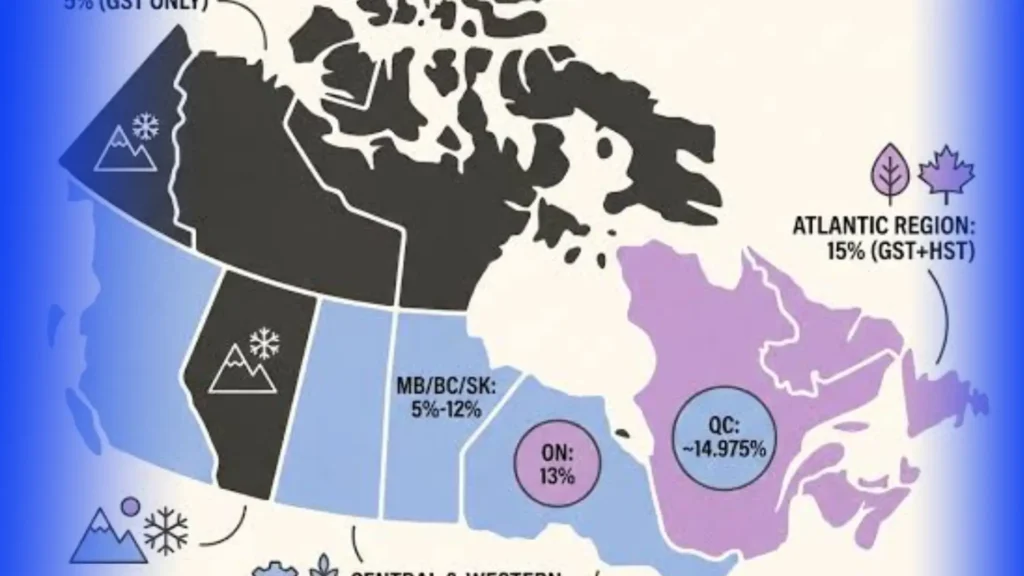
This comprehensive Quebec sales tax guide covers the entire lifecycle of sales tax for Quebec businesses. It addresses crucial aspects such as determining mandatory registration, distinguishing between taxable, zero-rated, and exempt supplies, accurately calculating and displaying combined sales tax, ensuring compliant invoicing, recovering input tax credits (CTI) and input tax refunds (RTI) on business purchases, selecting the most advantageous accounting method, timely electronic filing of returns, and avoiding late filing penalties. The guide also delves into numerous special cases, including deposits, gift cards, discounts, used goods, exports, imports, real property, and employee benefits, concluding with essential compliance rules like record keeping, audit procedures, and revocation of registration.
Sales Tax Calculator
Select a province or territory to apply its exact tax formula — combined HST, separate GST + PST/QST, or GST only — then enter an amount to see the breakdown.
References: Canada Revenue Agency · Revenu Québec (QST)
Key Insights: Rates and Calculation
Twelve Essential Points
- GST/TPS is 5% and QST/TVQ is 9.975%, resulting in a combined sales tax burden of 14.975% on a pre-tax price.
- QST/TVQ is calculated on the price before GST/TPS; both taxes apply in parallel, never one on top of the other.
- As long as your global taxable sales remain below $30,000 over four consecutive calendar quarters, you are a small supplier, and voluntary registration remains optional.
- A sale is taxable by default. A specific provision is required for it to be zero-rated (0% tax rate) or exempt (outside the tax regime).
- The distinction between zero-rated and exempt is vital: zero-rated supplies entitle you to CTI/RTI, while exempt supplies do not.
- Once registered, you can recover GST/TPS and QST/TVQ paid on your business purchases through input tax credits (CTI) and input tax refunds (RTI).
- Your invoices must include specific details, which vary depending on whether the sale exceeds $100 or $500.
- Taxes are collected on the earlier of two dates: when the payment is received or when the amount becomes due.
- Tax invoiced but not yet collected is considered "collected": it must be included in your return even if the client hasn't paid.
- As long as you are registered, a final return must be filed for each period—even if the balance is zero or there's no activity.
- Since 2024, electronic filing of returns is mandatory registration for almost all registrants.
- Amounts collected as taxes are not your property; they are held in trust for the government.
Current Rates (2026) for Quebec
| Tax | Rate | Collected for |
|---|---|---|
| GST/TPS | 5% | Federal Government |
| QST/TVQ | 9.975% | Quebec Government |
| Combined | 14.975% | — |
Basic Example: For a pair of shoes sold at $100: GST/TPS of $5.00, QST/TVQ of $9.98 (9.975% of $100, rounded), totaling $114.98.
Elsewhere in Canada: The HST
Five provinces, known as participating provinces, have merged their provincial sales tax with the GST/TPS to form the Harmonized Sales Tax (HST). If you sell to clients in these regions, their HST rates apply, not QST/TVQ. The following rates are effective from April 1, 2025:
| Province | Federal Portion | Provincial Portion | Total Rate |
|---|---|---|---|
| Prince Edward Island | 5% | 10% | 15% |
| New Brunswick | 5% | 10% | 15% |
| Nova Scotia | 5% | 9% | 14% |
| Ontario | 5% | 8% | 13% |
| Newfoundland and Labrador | 5% | 10% | 15% |
A registered Quebec business must collect HST on its taxable sales made in these provinces, following the same rules as GST/TPS. No separate accounting is required; HST collected or paid is declared on your regular GST/HST return, with only QST/TVQ tracked separately.
In other provinces and territories (Alberta, British Columbia, Manitoba, Saskatchewan, Nunavut, Northwest Territories, Yukon), only the 5% federal GST/TPS applies; a separate provincial tax may be added depending on the province.
Useful Fractions (Extracting Tax from Tax-Inclusive Amounts)
| Situation | Fraction |
|---|---|
| GST included in price | 5/105 |
| QST included in price | 9.975/109.975 |
| GST included (GST + QST included) | 5/114.975 |
| QST included (GST + QST included) | 9.975/114.975 |
| HST 15% included | 15/115 |
| HST 14% included | 14/114 |
| HST 13% included | 13/113 |
Calculating and Displaying Taxes Correctly
Two Methods, Depending on Your POS System
- Two-step method: Apply 5% to the selling price, then 9.975% to the same selling price. This is the standard method.
- One-step method: Apply 14.975% to the selling price.
Rounding Exception: If your cash register cannot handle three decimal places, you may use 9.97% (two steps) or 14.97% (one step). This tolerance applies only to this technical limitation, not for convenience.
What Must Never Appear on the Document: The rates of 9.97%, 14.97%, and 14.975% should not be shown on the invoice or receipt. The 9.975% QST/TVQ rate must be indicated, separate from the 5% GST/TPS.
Rounding: Only fractions of $0.005 and above are rounded up to the next cent. For multiple items, taxes can be calculated on the subtotal before rounding, rather than item by item.
Advertising: What You Can and Cannot Say
You must inform the client that taxes apply, whether through signage, receipts, invoices, or contracts. This can be done by stating the price separately from the taxes or by explicitly mentioning that taxes are included. Advertising should never imply that a sale is not taxable.
| Accepted Formulations | Prohibited Formulations |
|---|---|
| Taxes included | No GST/TPS or QST/TVQ |
| Taxes in | No taxes |
| GST/TPS and QST/TVQ extra | Tax-free |
| Taxes not included | Tax-free day |
There's no restriction on absorbing taxes into your price for commercial reasons, but you must then advertise "taxes included," not falsely claim there are no taxes.
Do You Need to Register for Taxes?
The Small Supplier Rule: The $30,000 Threshold
You are a small supplier if your total global taxable sales (including zero-rated sales and those of your associates) do not exceed $30,000 during any given calendar quarter or over the four preceding calendar quarters. For public service bodies (PSBs), this threshold increases to $50,000 (charitable organizations and public institutions also have a distinct revenue-based criterion).
Two important calculation details to prevent errors:
- A calendar quarter begins on January 1, April 1, July 1, or October 1. The four-quarter window can span two years (e.g., October 1 to September 30 of the following year).
- Sales of capital property (real estate, vehicles, equipment), goodwill, and financial services are excluded from this calculation.
Below this threshold, voluntary registration is possible. You will not collect any taxes but also cannot recover CTI/RTI on your purchases.
When the Threshold is Crossed
The moment you cease to be a small supplier depends on how the threshold is exceeded:
- If you exceed $30,000 in a single calendar quarter, you lose small supplier status immediately, starting with the sale that causes you to cross the threshold. That specific sale must already include taxes.
- If the excess occurs cumulatively over four quarters, you retain the status until the end of the month following that four-quarter period.
Cases Where Registration is Mandatory Registration
Certain activities require mandatory registration regardless of your sales volume:
- Operating a remunerated passenger transportation business (taxi or similar regulated vehicle), including transport organized or coordinated by an electronic platform.
- Non-resident artists selling admission rights in Canada.
- In Quebec, retail sales of tobacco, fuel, or alcoholic beverages.
- Sales of new tires or road vehicles (new or used, other than your own capital property), as well as their long-term rental.
Voluntary Registration
Even below the threshold, registering can be beneficial: it allows you to recover GST/TPS and QST/TVQ on your purchases and capital property. The calculation is simple: if your clients are also registrants (and thus indifferent to taxes, which they recover), registration is almost always advantageous. If your clients are individuals, it makes your prices 14.975% more expensive or reduces your margin by the same amount. Once registered, you must collect taxes on all your taxable sales and remain registered for at least one year.
Note: A small supplier who is not registered must still collect taxes on certain taxable sales of real property.
Ready to register? The process—where to register, required documents, and the difference between NEQ and tax numbers—is detailed in our guide on obtaining GST/QST tax numbers.
Sellers Outside Quebec: A Special Regime
Foreign suppliers and digital platforms selling in Quebec without operating a permanent establishment there register under a distinct designated registrant scheme: their QST/TVQ number contains the letters NR instead of TQ. The rules of this regime are not covered here, but they have a direct consequence for you if you purchase from them: see "QST paid to non-Quebec suppliers (NR numbers)."
Where is the Sale Deemed to Occur?
QST/TVQ applies to supplies made in Quebec, GST/TPS to those made in Canada, and HST to those made in a participating province. Determining the place of sale is thus the first question to resolve, especially if you invoice outside the province. Rules vary by the nature of the transaction.
Tangible Personal Property: A sale is deemed made in Quebec if the good is delivered to the buyer or made available there, including by mail, courier, or carrier engaged on the client's behalf. The delivery terms in the contract are decisive: wood sold "delivered to the buyer's factory" in the United States escapes taxes; the same wood picked up at your Quebec factory by a Manitoban buyer is supplied in Quebec (GST/TPS of 5%, QST/TVQ zero-rated if the good leaves Quebec within a reasonable timeframe without being consumed or transformed here, with shipping proof). A mail-order business collects the tax of the destination: GST/TPS + QST/TVQ for a shipment within Quebec, HST at the rate of the destination participating province, GST/TPS only elsewhere in Canada.
Rental of Tangible Personal Property: For rentals of three months or less, the place of delivery of the good determines the outcome, similar to a sale. Beyond three months, each rental period is treated as a distinct transaction, with the habitual location of the good, agreed upon by the parties at the start of each period, being the key factor. A generator rented for four years, stored in Quebec, then moved to Ontario in the third month, would switch from GST/TPS + QST/TVQ to HST for subsequent payments.
Services: The client's address obtained in the normal course of business is the anchor point: if you only obtain one address and it is in Quebec, the service is deemed rendered in Quebec—even if performed from elsewhere. Multiple addresses? Use the one most closely linked to the service. No Canadian address obtained? The service is deemed Québécois if the part performed in Canada is primarily (more than 50%) in Quebec. Conversely, a service rendered entirely abroad is never deemed rendered in Quebec, regardless of the client's address. Specific rules exist for transportation, telecommunication, postal services, and services related to real or tangible personal property.
Real Property: The location of the real property is decisive, regardless of the parties involved.
Intangible Personal Property (Licenses, Software, Rights): First, consider where the property can be used according to the contract: if the permitted Canadian use is primarily Québécois (more than 50%), the sale is deemed made in Quebec; if primarily outside Quebec, it is exempt. In the absence of a clear usage restriction, a sale of $300 or less concluded in person at a Quebec establishment of the supplier is deemed Québécois; otherwise, the client's address is used following the same cascade as for services. An intangible property related to real or tangible personal property follows the location of that property.
Participating provinces apply identical place-of-supply rules, which helps determine if HST (and at what rate) rather than GST/TPS alone applies.
Taxable, Zero-Rated, or Exempt: The Crucial Distinction
All sales are taxable by default. Exceptions fall into two categories, and neglecting the nuance between them can be very costly.
Taxable Sales (5% + 9.975%)
The general rule. This includes merchandise, professional services, IT development, design, marketing, restaurant meals, accommodation, gasoline, clothing, equipment, sales and rentals of commercial real estate, new residential real estate, retail sales and rentals of automobiles, hairdressing, soft drinks, confectionery, and chips, and consulting fees. Printed books with an ISBN are taxable under the GST/TPS regime (but zero-rated for QST/TVQ—see below).
Zero-Rated Sales (0% Rate)
The sale is within the tax regime but at a 0% rate. You do not charge any tax, but you can still recover the taxes you paid on your inputs (input tax credits (CTI) and input tax refunds (RTI)). This is the best of both worlds.
Examples of zero-rated supplies include:
- Basic groceries (everyday food items—not restaurant meals, most snacks, or soft drinks).
- Prescription drugs.
- Certain medical and assistive devices.
- Feminine hygiene products.
- Under the QST/TVQ regime only: certain breastfeeding items, as well as children's diapers and training pants.
- Most exports of goods and services (detailed conditions below).
- Certain passenger or freight transportation services.
- Certain agricultural and fishery products.
- Printed books with an ISBN, under the QST/TVQ regime only.
Exempt Sales
The sale is outside the tax regime. You do not charge anything, but you also cannot recover any taxes on related expenses. Taxes paid on your inputs become a sunk cost.
Examples of exempt supplies include:
- Residential rents of one month or more.
- Resale of previously occupied residential real estate.
- Most health, dental, and care services.
- Childcare services.
- A large portion of educational services and legal aid.
- Most financial services.
- Many supplies by charitable organizations, governments, and PSBs—for which a partial rebate partly compensates for taxes paid.
- Even the right to use common area laundry machines in a residential building is exempt.
Why the Nuance Matters
Two businesses invoice $0 in taxes to their clients. The first is zero-rated: it fully recovers GST/TPS and QST/TVQ on its rent, equipment, and supplies. The second is exempt: it absorbs these same taxes as an expense. At equal volume, the margin difference is considerable.
Invoicing and Collecting Taxes
Mandatory Invoice Details
Neither GST/TPS nor QST/TVQ imposes a specific invoice format, with two exceptions: restaurants and taxi businesses, which are subject to mandatory invoicing using a sales recording module or system (MEV/SEV). These businesses must, upon request from a registered client, provide a document linked to the MEV/SEV invoice containing the necessary information for their CTI/RTI.
For all businesses, the real constraint comes from supporting documents: your registered clients need specific information to justify their CTI/RTI, and you need the same from your suppliers to justify yours. The required content increases with the value of the sale.
| Information | Less than $100 | $100 to $499.99 | $500 and More |
|---|---|---|---|
| Supplier's name (or trade name, or intermediary's) | Yes | Yes | Yes |
| Invoice date (or date taxes paid/payable) | Yes | Yes | Yes |
| Total invoice amount | Yes | Yes | Yes |
| Applicable tax amount | Yes — QST/TVQ only | Yes | Yes |
| Supplier's GST/HST and QST/TVQ registration numbers | No | Yes | Yes |
| Purchaser's name (or trade name, or agent's) | No | No | Yes |
| Payment terms | No | No | Yes |
| Description identifying goods or services | Yes — QST/TVQ only | Yes — QST/TVQ only | Yes |
If the indicated tax amount combines GST/TPS and QST/TVQ, it must be specified for each taxable sale and noted that it includes both. The "intermediary" in the table is a registrant selling on behalf of the supplier (agent) or collecting payment for them.
Your Responsibility: It is your responsibility to ensure your supporting documents contain the required information. If not, your supplier is obliged to provide it in writing upon request—and vice versa for your registered clients.
When to Collect Taxes?
The general rule: On the earlier of two dates—the day the amount is paid, or the day it becomes due.
An amount is deemed due on the earlier of these dates:
- The day you first send the invoice.
- The date on the invoice.
- The day you would have sent the invoice if there had been no undue delay.
- The day stipulated by a written agreement.
Some common variations:
- Installment Payments: Taxes are collected on each installment, on the earlier of the two dates. If ownership or possession of tangible personal property transfers before full payment, taxes on the balance become due no later than the last day of the month following the transfer.
- Deposits: The general rule applies—taxes on the earlier of the dates the deposit is paid or becomes due. Be careful not to confuse this with a deposit, which follows its own logic (see special cases).
- Rental of Goods: No later than the date the rent is due according to the written lease.
- Construction Contracts: On holdbacks stipulated by law or written agreement, taxes are collected on the earlier of the dates—payment or due date of the holdback.
- Conditional or Installment Sales (sale on approval, deferred ownership until full payment): No later than the last day of the month following the transfer of possession or ownership, for any amount not yet paid or due.
- Automatic Vending Machines: Taxes are deemed collected on the day you remove money from the machine.
- Retail Sale of Road Vehicles: QST/TVQ is payable to the SAAQ upon registration. If the vehicle is not registered within 15 days of delivery, it becomes payable upon delivery.
Taxes Do Not Belong to You
Any amount collected as GST/TPS or QST/TVQ is held in trust for the government. This is not available cash; it is money you temporarily hold on behalf of others. Many businesses get into financial trouble by forgetting this.
If a client refuses to pay taxes:
You can take recovery action against them, under three conditions: you informed them that taxes applied, you declared these taxes in your returns, and you paid your net tax balance for the period. The same recourse exists if Revenu Québec assessed you for taxes you should have collected: pay the assessment, inform the client that taxes applied, and claim them from the client.
Recovering Paid Taxes: ITCs and ITRs
The input tax credit (CTI) recovers GST/TPS; the input tax refund (RTI) recovers QST/TVQ. This mechanism ensures that tax does not compound at each link in the supply chain; only the final consumer truly bears it.
The Three-Question Test
- Were taxes payable on the purchase? No tax paid, no credit—this applies to salaries, interest, dividends, insurance premiums, municipal taxes, and most fines and contributions.
- Is the good or service intended for your commercial activities? If it serves only partly, the credit generally follows the proportion of commercial use.
- Were you registered during the period when the tax became payable (or was paid)? Registration at the time of purchase is a fundamental condition.
What Qualifies for CTI/RTI
Goods and services acquired as inputs for your business: office furniture, computer systems, accounting fees, taxi fares, machine repairs, promotional materials, tools, commercial rent, and anything used or consumed in the course of your commercial activities.
What Never Qualifies
- Purchases intended for exempt sales (e.g., long-term residential rental is not a commercial activity).
- Purchases for personal use.
- Purchases from an unregistered person (no legitimate tax was paid).
- Membership fees for sports, golf, hunting, or fishing clubs—unless you purchase them for resale in the normal course of your business.
- Expenses without taxes: salaries, interest and dividends, insurance premiums, municipal, provincial, or federal taxes other than GST/TPS and QST/TVQ, most fees, fines, and contributions.
QST/TVQ Paid to Non-Quebec Suppliers (NR Numbers)
Since 2019, many foreign suppliers and digital platforms collect QST/TVQ under a designated registrant scheme: their registration number contains the letters NR instead of TQ. The rule is strict: QST/TVQ paid to an NR supplier does not qualify for any RTI, even for a 100% commercial purchase.
The right approach: If you are registered for QST/TVQ, provide your TQ number before the transaction. The NR supplier will then not have to collect QST/TVQ. If you paid it by mistake, you must claim the refund from them—not Revenu Québec. The list of suppliers registered under the designated registrant scheme is published on Revenu Québec's website, and a non-Quebec supplier storing goods in Quebec must, in principle, register under the regular regime.
Operating Expenses: The 10% / 90% Rule
| Commercial Use of Expense | Recoverable CTI/RTI |
|---|---|
| 10% or less | None |
| More than 10% and less than 90% | Proportional to commercial use |
| 90% or more | Full amount |
Mixed Activities: If you conduct both commercial and exempt activities, allocate each expense using a fair and reasonable method—such as area, time, costs, or revenues—and maintain the same method for at least one full fiscal year. Example: a commercial business on the ground floor (taxable) beneath a floor dedicated to an exempt activity; if the building's electricity is 60% for the commercial business, you recover 60% of the GST/TPS and QST/TVQ on the bill.
Capital Property: Different Rules by Asset Type
Capital property for tax purposes aligns with income tax definitions: depreciable property and property whose sale would yield a capital gain or loss. Notable exceptions: property in depreciation classes 12 (small tools, dishes), 14, 14.1 (goodwill and business intangibles), and 44 (patents) are not treated as capital property—apply the operating expenses rule above to them instead.
Moveable Goods (Equipment, Furniture, Machinery): The "All-or-Nothing at 50%" Rule
| Commercial Use | Recoverable CTI/RTI |
|---|---|
| More than 50% | Full amount |
| 50% or less | None |
A $4,000 computer used 60% for business qualifies for 100% of the taxes paid ($200 GST/TPS, $399 QST/TVQ)—not 60%.
Real Property: Pro-Rata, with Thresholds
| Commercial Use | All Registrants | Registered Individual | Registered PSB |
|---|---|---|---|
| 10% or less | None | None | None |
| More than 10% to 50% | Pro-rata use | Pro-rata—but none if personal use exceeds 50% | None |
| More than 50% to less than 90% | Pro-rata use | Pro-rata use | Full amount |
| 90% or more | Full amount | Full amount | Full amount |
A $500,000 building used 60% commercially qualifies for 60% of the taxes paid (CTI of $15,000, RTI of $29,925). PSBs apply an all-or-nothing at 50% but can choose general rules.
Passenger Vehicles and Aircraft
- For a corporation: The all-or-nothing rule for moveable goods (more than 50% commercial use = full amount).
- For an individual or partnership: Between 10% and 90% commercial use, recovery is spread over time: each year, the CTI is 5/105 of the depreciation claimed for income tax, and the RTI is 9.975/109.975 of that amount. At 90% or more, everything is recovered immediately.
In all cases, the recoverable tax on a passenger vehicle is capped at the maximum capital cost allowed for income tax (higher ceiling for a zero-emission vehicle); tax paid on the excess is lost.
Change in Use: The Taxman Follows Your Usage
The use of capital property evolves—and taxes follow. For moveable goods:
- Switching from primarily exempt or personal use to primarily commercial use? You recover a CTI/RTI equal to the tax content of the property at that time—roughly, the original tax adjusted to the current value of the property. Furniture paid $1,500 ($75 GST/TPS) becomes commercial when valued at $1,200: CTI of $75 × $1,200/$1,500 = $60, and RTI follows the same proportion.
- The inverse movement? You must remit the tax content: property paid $2,000 ($100 GST/TPS recovered) reallocated to primarily personal use when valued at $1,500 requires remitting $75 GST/TPS and $149.63 QST/TVQ.
Separate rules—pro-rata rather than all-or-nothing—apply to real property, passenger vehicles, and financial institutions. Remember the principle: increasing commercial use generates a credit, reducing it triggers a remittance.
Home Office Expenses
An individual (or a partnership, for an individual partner) can claim CTI/RTI on home office expenses if one of two conditions is met:
- The workspace is their principal place of business; or
- The space is used exclusively (90% or more) to earn business income and to meet clients regularly and continuously.
These are the same conditions as for the corresponding income tax deduction.
Meals and Entertainment: The 50% Limit
Recovery is limited to 50%, similar to income tax deductibility. Two ways to apply it, at your choice:
- Claim 100% as expenses occur, then re-integrate half of the claimed credits in a single adjustment: in the return for the fiscal year (annual frequency) or in the first return following the end of the fiscal year (monthly and quarterly frequencies).
- Directly claim 50% in each period and avoid further adjustments at year-end.
In addition, on the QST/TVQ side only, there's an annual cap based on sales volume:
| Sales Volume | Admissible Expense Limit |
|---|---|
| $32,500 or less | 2% of sales volume |
| More than $32,500 and less than $52,000 | $650 |
| $52,000 or more | 1.25% of sales volume |
Public service bodies (PSBs) and charitable organizations recover 100% of their meal and entertainment expenses related to commercial activities; specific rules apply to truckers. The 50% limit also applies to taxes reimbursed to your employees for their meal expense reports.
Claiming Deadlines
Generally, you have four years after the deadline of the acquisition period to claim a CTI/RTI. Specifically: purchases from December 2024, with quarterly returns, can be claimed until January 31, 2029. The deadline is reduced to two years for designated particular financial institutions and for registrants whose taxable sales exceeded $6 million in each of the two preceding fiscal years—except for charitable organizations and businesses whose 90% or more of sales (excluding financial services) are taxable, who retain their four years.
New Registrants: Don't Leave Anything on the Table
If you were a small supplier just before registering, you can claim a CTI/RTI on goods you held at the time of registration—including inventory and capital property—intended for your commercial activities. The amount generally corresponds to the tax content of the good at that time.
You are also entitled to taxes paid in advance on services rendered after your registration, as well as on rents, royalties, and similar payments relating to a period after registration. Amounts related to an earlier period are not recoverable: commercial rent paid in advance for 18 months, with registration occurring mid-term, is recoverable only for the months following registration. These credits are claimed from the first return.
Calculating Your Net Tax
For each period, the mechanism is the same for both regimes:
Net Tax = (Taxes collected or collectible) - (CTI or RTI to which you are entitled)
If the result is positive, you remit the difference. If it is negative, you claim a refund. Invoiced but uncollected taxes count among collectible taxes—hence the benefit of invoicing close to collection.
Compensation between the two regimes: If you file a single combined return, a GST/TPS balance due can be offset by a QST/TVQ refund, and vice versa—you then only pay the difference. Example: $1,200 GST/TPS collected versus $1,750 CTI (refund of $550), and $2,394 QST/TVQ collected versus $150 RTI ($2,244 due): a single payment of $1,694. This compensation is generally refused if you have other debts to the Canadian or Quebec governments, or if a prior return is missing. Branches filing separate returns can offset each other, provided they file simultaneously.
Choosing Your Accounting Method
The Simplified Method for Calculating CTI and RTI
This method avoids calculating the exact tax on each invoice. You work from the total of your purchases, tax-inclusive, and extract the taxes using a fraction. It doesn't change how you invoice or collect, and you must still retain your supporting documents.
Eligibility Conditions:
- Must be registered.
- Global taxable sales in the preceding fiscal year not exceeding $1 million (excluding taxes), including sales of associates—not counting financial services, real property, and goodwill.
- If adopting the method during the fiscal year: sales in quarters already passed in the fiscal year must also not exceed $1 million.
- Taxable purchases (other than zero-rated) in the preceding fiscal year not exceeding $4 million (tax-inclusive)—and, for a PSB, expect to respect this ceiling for the current fiscal year.
- Must not be a designated particular financial institution.
The Calculation, in Three Steps:
- Add up your eligible expenses and purchases for the period, tax-inclusive. Include reasonable tips, taxes and duties on imported goods, capital property in moveable goods used more than 50% for commercial purposes, expense reimbursements paid to your staff, penalties and interest paid on late settlement of a taxable purchase, and non-refundable provincial sales taxes (for CTI). Exclude notably: salaries, interest, and insurance (no tax paid); exempt or zero-rated purchases and non-taxable imports; purchases from non-registrants; personal expenses; 50% of meal and entertainment expenses; amounts paid or due before the election takes effect; passenger vehicles and aircraft used less than 90% commercially by an individual or partnership, and the portion of the cost of a passenger vehicle above the tax ceiling; purchases and rentals of real property; QST/TVQ itself in the CTI calculation.
- Extract the taxes. The RTI corresponds to 9.975/109.975 of the eligible total in QST/TVQ. For CTI, first subtract the RTI from the eligible total in GST/TPS, then apply 5/105. Purchases paid in HST are treated similarly, rate by rate. The results are entered on lines 106 (CTI) and 206 (RTI) of the return.
- Then add any CTI/RTI you had not yet claimed (if the deadline is still open), those related to purchases and rentals of real property, and those for a passenger vehicle or aircraft, if applicable.
A mixed-use property is only recoverable for its commercial portion, whether the simplified method is used or not.
How to Adopt It: No form to file—simply make the choice and document it. If your periods are annual, no later than the first day of the second quarter of the fiscal year; if monthly or quarterly, no later than the filing deadline for the first period affected. You must then use it for at least one year, unless you cease to meet the conditions during the fiscal year.
PSBs have a variation for their partial refunds: eligible total × 5/105 (or 9.975/109.975), then × their category's refund rate. And the simplified method combines with the quick method for goods to which quick method rates do not apply.
The Quick Method: Pay a Percentage of Your Sales
This is perhaps the most profitable—and most overlooked—provision for a small business in services.
The Principle: You collect GST/TPS and QST/TVQ normally from your clients, but remit only a reduced percentage of your tax-inclusive sales. In return, you waive claiming CTI/RTI on your regular expenses. If your inputs are low—the typical case for a consultant or freelancer—the difference remains in your pockets.
Who Can Use It:
Annual global taxable sales, over four consecutive fiscal quarters among the last five, must not exceed $400,000 (GST/HST included) and $418,952 (QST/TVQ included), including sales of associates. Zero-rated sales count; exempt sales, financial services, sales of real property and capital property, and goodwill are excluded from the calculation.
Who is Excluded: Designated particular financial institutions, charitable organizations, eligible non-profit organizations, and designated public service bodies, as well as businesses providing legal, accounting, or actuarial services, financial or tax consulting services, or bookkeeping or tax return preparation services.
Applicable Rates:
| Business Type | GST/TPS | QST/TVQ |
|---|---|---|
| Retailers & Wholesalers (goods bought for resale representing at least 40% of annual taxable sales—basic groceries and tax-free goods excluded from test) | 1.8% | 3.4% |
| Service Businesses (taxi, dry cleaning, delivery, auto repair, snack bars, travel agencies, small manufacturers, caterers, photographers, painting contractors, etc.) | 3.6% | 6.6% |
Rates apply to total taxable sales tax-inclusive—excluding zero-rated sales, sales of real property and capital property, and sales made without taxes to First Nations members or a provincial government that does not pay them. If you sell in participating provinces, different rates apply depending on the province.
The 1% Credit:
If you use the method from the beginning of your fiscal year (or your registration), a 1% credit applies to the first $30,000 of taxable sales (GST/TPS inclusive) and $31,421 (QST/TVQ inclusive) of each fiscal year. For monthly or quarterly frequency, the credit is consumed period by period until the tranche is exhausted. It is claimed as an adjustment, on line 107 for CTI and line 207 for RTI. The unused portion does not carry over to the next fiscal year.
What Remains Recoverable:
Despite the quick method, you can still claim CTI/RTI on land and property qualifying for a capital cost allowance: buildings, vehicles, office furniture. Conversely, the reduced rates only apply to your regular transactions; a sale outside the normal course of business—land, used depreciable equipment—is fully remitted.
How to Adopt It: You must file form FP-2074. For monthly or quarterly periods, no later than the due date of the return concerned; for annual periods, no later than the first day of the second quarter of the fiscal year. Revenu Québec confirms the choice in writing; the effective date corresponds to the first day of a reporting period. The election applies to all your branches, remains valid as long as you meet the conditions, must be maintained for at least one year—and is revoked using the same form. An estimation tool for savings is available on Revenu Québec's website.
A Tax Nuance Not to Be Missed: The portion of collected taxes you do not remit thanks to the quick method constitutes taxable income. It must be included in the calculation of your business income.
The Special Quick Method for PSBs
Certain organizations use specific regulatory percentages tailored to their category (form FP-2287):
| Organization Type | GST/TPS | QST/TVQ |
|---|---|---|
| Hospital Authority, Institution Operator, External Supplier | 4.5% | 7.3% |
| School Authority | 4.4% | 7.3% |
| Municipality | 4.7% | 7.3% |
| Eligible Non-Profit, Designated Charity | 3.6% | 7.3% |
| University or Public College | 4.1% or 4.4% | 7.3% |
The 4.1% rate applies to universities and colleges where at least 25% of sales are through vending machines. Non-designated charitable organizations do not have access to this method; a specific net tax calculation applies by default to them.
Partial Rebates for Public Service Bodies (PSBs)
PSBs that cannot claim CTI/RTI (because their activities are exempt) are entitled to a partial rebate of taxes paid.
| Organization Type | GST/TPS | QST/TVQ |
|---|---|---|
| Municipality | 100% | 50% |
| School Authority | 68% | 47% |
| University or Public College | 67% | 47% |
| Hospital Authority | 83% | 51.5% |
| Charitable Organization or Eligible Non-Profit | 50% | 50% |
The claim is made using form FP-2066, within four years following the end of the reporting period in which the tax became payable. HST paid in a participating province qualifies for a rebate of its federal portion.
Declaring and Paying Taxes
Electronic Filing is Mandatory
As of January 1, 2024, all registrants—with the exception of charitable organizations—must file their returns electronically for periods beginning after 2023: via My Account for Businesses or through the filing service of most financial institutions. A penalty applies for non-compliance.
Your Reporting Frequency
It is assigned to you upon registration, based on your projected annual total of taxable sales in Canada (including those of your associates), and appears on your registration confirmation.
| Annual Taxable Sales | Assigned Frequency | Other Possible Frequency |
|---|---|---|
| More than $6,000,000 | Monthly | None |
| More than $1,500,000 to $6,000,000 | Quarterly | Monthly |
| $1,500,000 or less | Annual (with or without installments) | Monthly or Quarterly |
You can change your frequency (form FP-2620), but must usually keep the new choice for at least one year. If you expect to be frequently in a refund position, filing more often improves your cash flow. For your periods to coincide in both regimes, your fiscal year must be the same for GST/TPS and QST/TVQ—usually the income tax year. Charitable organizations freely choose their frequency; under the QST/TVQ regime, clothing manufacturers must file monthly.
Deadlines
| Frequency | Due Date |
|---|---|
| Monthly or Quarterly | One month after the end of the period |
| Annual — Filing | Three months after the end of the period |
| Annual — Installment Payments | Last day of the month following each quarter of the fiscal year |
| Individual Business (fiscal year ending Dec 31) — Filing | June 15 |
| Individual Business (fiscal year ending Dec 31) — Payment | April 30 |
The June 15 Trap: A self-employed individual (business income for income tax, annual frequency, fiscal year ending December 31) has until June 15 to file their return but must pay no later than April 30. Two different dates for the same return: a classic source of interest charges.
Installment Payments
If you file annually, you must make four installment payments when your net tax reaches $3,000 or more for both the current year (estimated) and the previous year. Each installment is due one month after the end of each quarter of your fiscal year; the annual return then reconciles the amounts. The $3,000 threshold applies to the entire business, not branch by branch. The rule applies separately for each regime—as the QST/TVQ rate (9.975%) exceeds that of GST/TPS (5%), it is possible to owe installments for QST/TVQ without owing any for GST/TPS (form VDZ-458.0.1 for QST/TVQ alone; remittance slip FPZ-558 for both).
The Payment
Via online services, at a financial institution counter or ATM, or by mail with the remittance slip—but any amount of $10,000 or more must be paid electronically, under penalty (unless it is reasonably impossible). Your payment is deemed received on the date Revenu Québec receives it—a post-dated cheque for less than $10,000 counts on the date it becomes cashable—or on the date the financial institution processes it: consider banking delays. And never send cash by mail.
Designated Reporting Periods
A registrant whose activity is seasonal or temporary can request designated reporting periods, avoiding the need to file returns during slow months, provided that the taxes involved (collected, collectible, and adjustments) do not exceed $1,000 for the period(s) concerned—taxes collected during a designated reporting period are then carried over to the next return. The request is made by signed letter, upon registration or before the first period concerned, including start and end dates for each period, legal name, and, if applicable, affected branches. You must be up-to-date with your obligations to Revenu Québec and the CRA; annual frequency generally does not grant access.
Your Refunds
Revenu Québec processes refunds diligently. After 29 days (GST/TPS) or 45 days (QST/TVQ) from the receipt of the return, interest begins to accrue in your favour. No refund is issued until all required returns—for taxes or other tax laws—are filed, and a debt to either government may offset it. Enrolling in direct deposit (via My Account or form LM-2) speeds up payments and protects against lost cheques.
Correcting a Return
Use form FP-2500.E for an online return, or FPZ-2500 for a paper return covering a period ended before January 1, 2024. A separate form is required per period.
Penalties and Interest
GST/HST Regime
In case of late filing, the penalty is the total of:
- 1% of the unpaid amount on the due date; plus
- 0.25% of this amount multiplied by the number of full months of delay, up to a maximum of 12 months.
No penalty if the balance is zero or it's a refund. A separate penalty applies if you fail to file electronically when required.
QST/TVQ Regime
Sanctions are significantly heavier:
- $25 per day of late filing, up to a maximum of $2,500.
- On amounts remitted late: 7% if the delay does not exceed 7 days, 11% between 8 and 14 days, 15% beyond 14 days.
- 15% of any amount you failed to collect.
- 15% of any refund obtained without entitlement or in excess.
In both regimes, unpaid amounts bear interest at the prescribed rate, revised quarterly and compounded daily.
Practical Tips for Freelancers and Self-Employed Individuals
Do you invoice under your own name or through your corporation? A complete overview of the status—definition, taxes, incorporation—is in our guide for freelancers in Quebec. The following tips help avoid most common issues:
- Monitor your threshold monthly: Maintain a rolling cumulative total of your taxable sales over twelve months. The $30,000 small supplier threshold is often crossed unexpectedly—and crossing it "mid-quarter" obliges you to collect taxes from that specific sale.
- Register before your first major purchase: If you plan to buy equipment, a vehicle, or IT hardware, voluntary registration beforehand allows you to recover 14.975% of the price. On $20,000 of equipment, this represents approximately $2,995.
- Seriously evaluate the quick method: If you primarily sell time and ideas—thus incurring few taxable inputs—the difference between the 14.975% collected and the 3.6% (GST/TPS) + 6.6% (QST/TVQ) remitted remains in your pockets, less applicable taxation. Do the math before dismissing this option. Note, however, that accountants, lawyers, actuaries, bookkeepers, and tax or financial advisors are excluded.
- Open a separate account for taxes: Amounts collected are held in trust. Transferring them monthly to a separate business account prevents the most classic scenario: discovering at the payment due dates that the money was used for something else.
- Perfect your templates from the start: Your GST/TPS and QST/TVQ registration numbers, the 9.975% rate displayed separately from the 5%, a clear service description, and the date. A correct template from the first invoice is better than retroactive corrections over twelve months.
- Claim only what is justified: A CTI/RTI without a compliant document will be denied in an audit, with interest. Especially verify that your suppliers indicate their registration numbers for purchases over $100.
- Verify the status of your suppliers: No tax paid to an unregistered person qualifies for anything—and QST/TVQ paid to an NR number doesn't either. If someone invoices you for "taxes" without a registration number, there's a problem.
- Document your grey areas: If the classification of a sale (taxable, zero-rated, or exempt) is uncertain, write down your reasoning and keep it. In case of an audit, documented analysis carries significant weight.
- Anticipate April 30: If your fiscal year ends on December 31, your return can wait until June 15—but your payment cannot.
Vocabulary to Master
Some terms appear constantly and don't quite have their common meaning.
- Supply (or Sale): Any provision of a good or service, whether by sale, barter, exchange, transfer, lease, or gift.
- Good: Any moveable or real property, tangible (equipment, inventory, cash register) or intangible (license, patent, share, copyright)—but not money.
- Service: Anything that is not a good, money, or the work of an employee for their employer.
- Commercial Activity: The operation of a business that results in taxable sales, including zero-rated. Activities that only produce exempt sales are not part of it—nor, for an individual, a personal trust, or a partnership of individuals, a venture carried out without a reasonable expectation of profit.
- Person: An individual, a corporation, a partnership, a trust, an organization.
- Registrant: A person registered for GST/HST and QST/TVQ, or who should have been. A single number covers GST/TPS and HST.
- Consumer: An individual who acquires a good or service at their own expense for personal use, not as part of a business.
- Consideration: What is given in exchange for the supply—usually the price, but not necessarily money. It never includes the taxes themselves.
- Fair Market Value (FMV): The highest price a good would fetch on an open market between willing, informed, and independent parties, excluding taxes.
- Tax Content: Simply put, the residual tax "incorporated" into a good—the tax paid upon acquisition and on improvements, minus what was recoverable, adjusted for depreciation (at the ratio of current FMV to original cost, capped at 1). This concept is used at the time of registration, changes in use, and revocation.
- Small Supplier: A person whose taxable sales remain below the regulatory threshold (see above).
- Non-Profit Organization (NPO): An entity constituted and administered exclusively for non-profit purposes, whose revenues do not personally benefit its members. An eligible NPO derives at least 40% of its revenues from public funding.
- Charitable Organization: An organization registered under income tax laws—excluding public institutions (a registered organization that is also a school, hospital, or municipal authority is treated as a public institution).
- PSB (Public Service Body): A charitable organization, NPO, municipality, school or hospital authority, university, or public college.
- Participating Province: A province where HST replaces GST/TPS—Prince Edward Island, New Brunswick, Nova Scotia, Ontario, Newfoundland and Labrador.
Special Cases
Cash Discounts and Late Fees
If you offer a discount for prompt payment, taxes are calculated on the total invoice amount—whether the client takes advantage of the discount or not: on $100 with a 2% discount, GST/TPS remains $5.00 and QST/TVQ $9.98, the client pays $112.98. Conversely, if you charge late fees, taxes are calculated on the amount before these fees. And if you initially invoice an already reduced amount, taxes apply to the invoiced amount.
Price Reductions
Granted at the time of sale, the reduction lowers the taxable base: taxes apply to the net price. Granted afterwards (e.g., an annual rebate), you have a choice:
- Adjust taxes: In the period when the reduction is granted or within four years. A credit note must then be issued to the client (or a debit note received from them); you deduct the adjusted amount from your net tax, and the registered client reduces their already claimed CTI/RTI accordingly.
- Do not adjust: The reduction is then deemed tax-free, without paperwork, which is often simpler when the buyer is a registrant who has already recovered their credits.
Deposits and Returns
A deposit is not taxable until it is applied to the selling price. But if the client cancels their purchase and you keep the deposit, it is deemed to include taxes: extract them using the fractions 5/105 and 9.975/109.975 (or the applicable HST fraction). On a retained $50 deposit: $2.38 GST/TPS and $4.54 QST/TVQ to remit—which your registered client can claim as CTI/RTI.
In case of merchandise returns, you can refund or credit the taxes, with a credit note as proof. If you only refund a percentage of the price (keeping re-packaging fees), only refund the same percentage of the taxes. The refund is deducted from your net tax for the period; the registered client re-adjusts theirs.
Content of a credit note: Mention that it's a credit note; your name and registration numbers; the client's name; the date; and the amount of the tax adjustment (or the mention that the total includes it, with the rate per item and the reduction concerned). A debit note issued by the client, with the same information, also suffices.
Promotional Gifts and Free Samples
No tax to collect on gifts offered free of charge or as premiums. You retain the right to CTI/RTI on their acquisition, to the extent they serve to promote your taxable sales.
Gift Cards and Gift Vouchers
Their sale is not taxable. Taxes are calculated at the time of use, on the price of the good or service purchased, as if paid in cash. The card's value is then subtracted from the tax-inclusive total: a $35 record paid with a $30 card results in $40.24 tax-inclusive, minus $30—the client pays $10.24.
Discount Vouchers
- Redeemable vouchers (manufacturer vouchers—remitted to a third party for reimbursement, fixed discount, taxable sales only): Taxes are deemed included in their face value. The retailer calculates taxes on the full price, then deducts the voucher value from the tax-inclusive total—whether prices are displayed with or without taxes, the client pays the same. The manufacturer then recovers the taxes included in the voucher (5/105 and 9.975/109.975). The downside for a registered buyer: their CTI/RTI must be reduced by the same fractions of the voucher value, as they did not actually pay this tax.
- Non-redeemable vouchers (issued by the retailer): The voucher value reduces the price before tax calculation—a $100 tool with a $10 voucher is taxed on $90. No CTI/RTI for the retailer on the voucher value. A retailer issuing their own vouchers can choose either treatment.
- Other vouchers (percentage discounts, "buy one get one free," variable discounts): Treated as non-redeemable vouchers, thus deducted before tax calculation.
Manufacturer Rebates
Two mechanisms, one principle: the rebate does not reduce the retailer's taxable base.
- Mail-in rebate: The client buys at the current price, taxes on the full price, then receives their cheque from the manufacturer—a separate transaction between them.
- In-store applied rebate (common at dealerships): Taxes are calculated on the retail price before the rebate. A $30,000 car with a $1,000 rebate: GST/TPS of $1,500, QST/TVQ of $2,992.50 (paid to the SAAQ), rebate deducted from the total.
The manufacturer then recovers the taxes included in the rebate (5/105 in CTI, 9.975/109.975 in RTI); a document must specify that part of the rebate represents taxes.
Used Goods and Trade-ins
The sale of used goods is generally taxable at normal rates, including for a registered antique dealer or property seized and repossessed by a creditor. It is not taxable if made by a person not engaged in commercial activities—a garage sale between individuals, for example. Flea market vendors follow ordinary registration rules, whether goods are new or used.
Under the QST/TVQ regime, the sale of a road vehicle requiring registration remains taxable even between individuals; QST/TVQ is then collected by the SAAQ upon registration (vehicles under 4,000 kg), generally on the higher of the price paid or the estimated value of the vehicle.
In case of a trade-in:
- If the seller of the traded-in good is a registrant who used it for commercial purposes, there are two distinct operations, each taxable on its full price—each invoices, each recovers their credits.
- If the seller is not registered (or did not use the good commercially), taxes are calculated on the net amount—the price of the good sold minus the trade-in value—provided that the buyer of the new good is also the owner of the traded-in good. A new $500 lawnmower with a $100 trade-in of the old one is taxed on $400, and the merchant has no CTI/RTI on the trade-in.
Traded-in Road Vehicles: QST/TVQ Specificity—a vehicle traded in by a registrant to a vehicle dealer is zero-rated if the dealer acquires it for resale or long-term rental (one year or more).
Sales to Governments
The Government of Canada and the Government of Quebec, their ministries, corporations, agencies, and mandataries pay GST/TPS and QST/TVQ on their taxable purchases. You must therefore invoice them normally—and they themselves collect taxes on their own taxable sales.
Sales to First Nations Members
Taxes generally apply to sales made to First Nations members (certified status card Indians as per the Indian Act), band councils, tribal councils, and entities mandated by a band—as well as to anyone purchasing on a reserve without being a member. However, the exemption applies notably in the following situations:
- Goods are purchased on a reserve or delivered there by the seller or their agent (for a corporate mandated entity, goods must also be used for band management activities or relate to reserve real property).
- Services are rendered entirely on a reserve, to a member located there or on property located there.
- Transportation begins and ends on a reserve.
- Services, even rendered off-reserve, relate to a right to real property located on a reserve.
- Services acquired by a band council or mandated entity are for band management or reserve real property—travel expenses (transport, accommodation, meals) incurred off-reserve remain taxable, with possible reimbursement.
Proof is everything. Indicate the registration number of the certified status card (or band name and family number) on the invoice; for delivery on the reserve, retain proof of delivery (form LE-20 if you deliver yourself); for a band council or mandated entity, a certificate of use. Stores in remote areas with primarily reserve clientele can, under certain conditions, sell tax-free even without delivery on the reserve.
You retain the right to CTI/RTI on purchases serving these sales, even without collecting taxes—and it is recommended to distinguish these sales in your records.
Mohawks of Kahnawake: Special measures provide a QST/TVQ exemption on goods sold to them—excluding restaurant meals, fuel, alcoholic beverages, and cannabis—by businesses in the Roussillon RCM (Candiac, Châteauguay, Delson, La Prairie, Léry, Mercier, Saint-Constant, Sainte-Catherine, Saint-Isidore, Saint-Mathieu, Saint-Philippe) and several municipalities on Montreal Island and the South Shore (including Montreal, Longueuil, Brossard, and Saint-Lambert). The client presents their certified status card and identification; the merchant records their name and certificate number on the invoice.
Foreign Representatives and Diplomatic Missions
Diplomatic missions, consular posts, international organizations, and foreign armed forces units—as well as their foreign representatives and officials—pay taxes upon purchase: no identification card allows them to avoid it at the checkout. They can then claim a refund (form FP-2498) within two years of payment. Targeted relief also exists for their purchases of tobacco and alcohol at designated points of sale.
Sale of a Business
The seller and buyer can jointly elect (form FP-2044, submitted by the buyer if registered) that GST/TPS and QST/TVQ do not apply to the sale of a business—or part of a business forming a self-sufficient functional unit. Three conditions:
- The business sold was established or operated by the seller (or by the person from whom they acquired it).
- The buyer acquires 90% or more of the goods reasonably considered necessary for operation—necessary goods they already hold or obtain elsewhere must not exceed 10% of the FMV of the whole—and must be able to operate the same type of business.
- The seller-buyer pair is eligible: both registered, both unregistered, or unregistered seller with registered buyer. The election is impossible if the seller is registered and the buyer is not.
The sale of isolated assets—even valuable, even indispensable—is not a sale of a business. And despite the election, taxes continue to apply to services rendered to the buyer, goods supplied by lease or license, and real property sold to an unregistered buyer.
Principals and Agents
When an agent sells on behalf of a principal who should have collected taxes, it is the principal who collects and declares taxes on the sale; the agent collects taxes on their commission. A joint election (form FP-2506) allows transferring the collection and remittance obligation to the agent; both then become jointly and severally liable.
The inverse common case—the principal would not have had to collect (e.g., an individual having their boat sold by a dealer): it is then the registered agent who is deemed to sell the good and collects taxes on the selling price… but not on their commission. A written election can reverse this treatment if the principal is registered. Auctioneers follow their own rules.
Exports
Goods: The export of tangible personal property outside Canada is generally zero-rated, as is shipment outside Quebec for QST/TVQ. Cumulative conditions when the buyer exports: they are not a consumer; the good is not an excise-taxed product (alcohol, tobacco, cannabis, vaping); it is exported within a reasonable time, without being consumed, used, or sold in Canada beforehand, and without transformation other than that required for transport; and you retain proof of export—it will be requested in an audit. For electricity, oil, or gas exported by wire or pipeline, the buyer must not be a registrant.
Zero-rating is automatic when you are the one shipping: foreign destination specified in the transport contract, delivery to a common carrier engaged on the buyer's behalf, or shipment by mail or courier to a foreign address.
Also know:
- A non-resident, unregistered buyer who fails the conditions pays the taxes but can claim a refund if they export the good within 60 days and use it primarily outside Canada.
- Export trading houses (90% or more export activities or resale outside Quebec) can obtain certificates allowing them to purchase tax-free; the same logic applies to distribution centers that add only limited value to goods.
- Goods sold to non-resident consumers remain taxable; targeted refunds exist for foreign conventions.
- A Canadian resident from another province can claim QST/TVQ paid on property carried or shipped out of Quebec (forms VD-352, or VD-60.R for a road vehicle).
Services: Services rendered in Quebec to a non-resident are generally zero-rated—except, notably, if they are rendered to an individual present in Canada during the provision or at the time of their request. Examples of zero-rated services: advisory or professional services rendered to a non-resident, those assisting them to establish residence or business in Canada, advertising services sold to an unregistered non-resident, warranty services, and training leading to professional certification sold to a non-resident who is neither an individual nor a registrant. Also zero-rated: services rendered on property habitually located abroad, imported solely for that service (e.g., repair) then re-exported without delay.
Intangible Property: Their sale to an unregistered non-resident is zero-rated, unless the intangible property is sold to an individual present in Canada, relates to real or tangible property located in Canada, relates to a non-zero-rated Canadian service, can only be used in Canada, or consists of a telecommunication installation.
Imports
Goods: The import of goods into Canada is generally taxable at 5% (GST/TPS), collected at customs on the value after customs duties—recoverable as CTI if the purchase is commercial. The bringing of goods into Quebec is at 9.975% (QST/TVQ). A registrant for QST/TVQ does not, however, have to pay QST/TVQ on bringing in a good exclusively intended for their commercial activities that would qualify for an RTI—the same exemption applies for goods brought in from another province; otherwise, QST/TVQ is declared (self-assessment) (forms FP-505 and FP-505.D.D for non-registrants). Some imports escape taxes: certain medals and trophies, donations imported by a charitable organization, free replacement parts under warranty.
Services and Intangibles: You generally do not have to pay taxes on services and intangible property acquired from an unregistered non-resident who does not operate a business in Canada, if you use them exclusively (90% or more) in your commercial activities—the case of an American consultant designing your IT system. Below this threshold, self-assessment applies: you calculate and remit GST/TPS and QST/TVQ yourself on the price paid. And if the non-resident supplier is registered and the sale takes place in Quebec, you pay taxes to them, as usual.
Bad Debts
If you write off a debt from your books, you can recover taxes already declared and remitted, provided the debtor is not related to you—and the debt is truly uncollectible: collection efforts made, write-off accounted for, proof retained. The adjustment is calculated pro-rata to the unpaid balance: on an invoice of $149.46 (including $6.50 GST/TPS and $12.97 QST/TVQ) paid $30, you recover $5.20 GST/TPS and $10.37 QST/TVQ. It must be made in a return filed no later than four years after the deadline of the period in which the debt was written off.
If the client pays you later, you remit the corresponding taxes, again pro-rata. Under the quick method, this mechanism only applies to sales to which the reduced rates did not apply.
Automatic Vending Machines
Sales by automatic machine are taxable, including for foods usually zero-rated like milk or fruits. Taxes are deemed included in the price and collected when you empty the machine: extract them from the money withdrawn using the fractions 5/114.975 (GST/TPS) and 9.975/114.975 (QST/TVQ)—on $100 withdrawn, $4.35 and $8.68—and declare them in the period of withdrawal. Exceptions: mechanical devices accepting only a single $0.25 coin or less per transaction are exempt from declaration, and the right to use washers and dryers in a common area of a residential building is exempt.
Returnable Containers
The refundable deposit on beverage containers is not taxable. Other returnable containers (barrels, gas cylinders) generally follow the tax treatment of the product they contain: the sale of a container filled with zero-rated medical oxygen is zero-rated, but the sale of the empty container is taxable at normal rates. Upon return of the container, two possible treatments: a resale to the supplier (the registered buyer collects taxes, the supplier recovers them as CTI/RTI) or a refund with a credit note—parties can also agree to refund only the deposit, without affecting taxes, if each has already settled their accounts. Packaging sold with its content follows the content's treatment if it's an accessory; otherwise, its portion of the price is taxed separately.
Real Property
The taxable sale of real property normally obliges the seller to collect taxes—except in two cases where the buyer must remit them directly (self-assessment):
- The seller is not a resident of Canada (or Quebec for QST/TVQ).
- The buyer is a registrant—subject to exceptions for an individual acquiring residential real property or a cemetery plot.
The terms depend on the buyer's profile. A registrant who intends the property primarily (more than 50%) for their commercial activities remits the taxes in their regular return (the "taxable real property" section of detailed calculation forms)—and can offset them at the same time with the CTI/RTI to which the purchase entitles them, to pay only the net tax. In other cases—registrant for primarily non-commercial use, or unregistered person (forms FP-505 and FP-505.D.A)—taxes are remitted no later than the last day of the month following the one in which they became payable.
Two safety nets: the unregistered seller who could not recover taxes paid upon acquisition of the property can claim a refund (form FP-2189); and the buyer who paid taxes to the seller when they should have remitted them themselves must still remit them—then claim from the seller, or request a refund of taxes paid in error within two years.
Deemed Sale of Residential Real Property to Self
A builder who rents or occupies for residential purposes a residential property they have constructed or undergone a major renovation is deemed to have sold it—and re-purchased it—to themselves: they must remit taxes calculated on the FMV of the property. The deemed time of sale is the later of these days: work almost completed, possession transferred to the first tenant, or occupation by the individual builder.
A builder is one who builds or performs major renovation on land they own or lease, but also the seller of new mobile homes, the buyer-reseller of new unoccupied properties, the acquirer of a right to a property under construction, or one who converts a commercial property into residential property. Not a builder: an individual who builds outside any business endeavour.
The mechanics are consistent: the registered builder recovers their CTI/RTI on construction costs, remits taxes on the FMV (in their return if registered, otherwise with form FP-505.2), and the subsequent resale of the property generally becomes exempt. The unregistered builder recovers taxes paid on their costs by refund (form FP-2189) after self-assessment.
Notably exempt from the rule: an individual who occupies the property primarily as a residence without having claimed CTI/RTI on its construction; student residences of universities, public colleges, and school authorities; certain religious communities; and, by election, remote construction site housing for employees.
New Housing Rebates
The buyer of a new home (or one that has undergone major renovation) used as a principal residence—for themselves, a relative, or a former spouse, as the first occupant—recovers a portion of the taxes paid:
| Regime | Rebate Rate | Maximum | Price Ceiling |
|---|---|---|---|
| GST/TPS | 36% of tax paid | $6,300 | Full rebate up to $350,000, decreasing from $350,000 to $450,000, zero beyond |
| QST/TVQ | 50% of tax paid | $9,975 | Full rebate up to $200,000, decreasing from $200,000 to $300,000, zero beyond |
The claim is made via form FP-2190.AC (purchase from a builder—who can also pay or credit the rebate directly to the buyer) or FP-2190.P (owner-built, major renovation, co-ownership, mobile home).
For a new rental housing property intended for long-term leases, the rebate is 36% in both regimes, capped at $6,300 (GST/TPS) and $7,182 (QST/TVQ) per dwelling—claimed by separate forms (FP-524 for GST/TPS, VD-370.67 or VD-370.89 for QST/TVQ), and never credited by the builder. The builder who self-assesses on the FMV under the deemed sale to self also qualifies.
New GST Rebate for First-Time Homebuyers (announced May 27, 2025): This federal rebate can increase GST/TPS recovery to 100%, up to a maximum of $50,000, for the purchase of a new home or one that has undergone major renovation—purchased from a builder (including on long-term leased land), owner-built, or owned through housing cooperative shares.
It targets homes up to $1,000,000 (or $1,050,000 for a cooperative share or home on leased land); it linearly decreases up to $1,500,000 (or $1,575,000), beyond which it becomes null.
The buyer must be 18 or older, a Canadian citizen or permanent resident, the first occupant of the home and make it their habitual residence; neither they nor their spouse must have occupied a home they owned during the current or previous four years, nor have previously received this rebate. Calendar-wise: work started after March 19, 2025, and before 2031 (contract concluded within the same window, if applicable), home substantially completed before 2036, and ownership transferred before 2036. The claim is made via form FP-2190.APH—or by the builder, if they pay or credit the rebate.
Quebec Does Not Harmonize This Measure: This new rebate targets only GST/TPS. The Government of Quebec has not harmonized QST/TVQ with this temporary relief.
Taxable Benefits for Personnel
Salaries, commissions, and tips are not taxable, but taxable benefits are: personal use of an employer-provided vehicle, board and lodging, non-cash prizes, travel programs, gifts over $500.
| Type of Benefit | GST/TPS | QST/TVQ |
|---|---|---|
| Benefits related to automobile operating expenses | 3% | 6% |
| Other benefits | 4/104 | 9.975/109.975 |
These taxes become due on the last day of February each year—the deadline for employment income slips, whose declared benefit value includes taxes—and are declared in the period covering that date.
The logic reverses when the credit was prohibited: property acquired exclusively (90% or more) for an employee's personal use, or a sports club membership, yields no CTI/RTI to the employer—and no tax is then remitted on the corresponding benefit.
Allowances and Expense Reimbursements
An allowance is an amount paid without requiring accounts; a reimbursement requires supporting documents. The distinction dictates the employer's credit calculation—the same rules apply to a partnership paying a partner and an organization paying a volunteer.
Allowance: A registered person who pays an allowance can claim a CTI of 5/105 and an RTI of 9.975/109.975 of the allowance, provided it is reasonable, tax-deductible, and paid for expenses 90% or more taxable, incurred in Canada (GST/TPS) or Quebec (QST/TVQ)—typically mileage, meal, accommodation, or transportation allowances.
Reimbursement: Two methods to choose from—
- The factorial method: CTI of 4/104 and RTI of 9/109 of the reimbursed amount, usable if at least 90% of reimbursed expenses were taxable—simpler for documentation.
- The actual amount of taxes paid, multiplied by the lesser of the percentage reimbursed and the proportion of commercial use—with complete supporting documents.
The chosen method must be applied uniformly by expense category (transport, accommodation…) throughout the fiscal year, and meal restrictions apply in all cases.
Employee and Partner Refunds
Employees of a registrant and partners of a registered partnership who deduct unreimbursed employment expenses (travel, meals…) for income tax can recover taxes directly: form GST370 for GST/TPS (5/105 of eligible expenses, within four years of the year concerned) and VD-358 for QST/TVQ (9.975/109.975).
GST Refund for Printed Books
Municipalities, school authorities, universities, public colleges, charitable organizations, public institutions, and eligible non-profit organizations that operate a public lending library—as well as literacy organizations recognized by regulation—can obtain a full refund of GST/TPS on their purchases of printed books, audio recordings of these books, and religious scriptures, provided these works are not intended for resale or transfer as part of another sale. The claim is made via form FP-2066, within four years. This refund does not exist for QST/TVQ—the sale of printed books with an ISBN is already zero-rated.
Compliance, Audit, and Cancellation of Registration
Records, Supporting Documents, and Audit
What you must keep:
Upon registration, you must record taxes you collect and those you pay. Your supporting documents must mention the supplier's name, invoice date, and information required to justify your CTI/RTI. Documents must be kept at your establishment or residence (or any other location designated by Revenu Québec).
How long:
Six years following the end of the last year to which the documents relate. This period is extended if you file an objection, make an appeal, or are party to an appeal; it is only shortened with written authorization from Revenu Québec. Records can be on paper, electronic media, or microfilm, provided they remain legible and allow for the production of usable copies. Non-compliance with this obligation may result in criminal prosecution and a fine.
The tax audit:
Revenu Québec can audit a business to ensure compliance with its obligations. Audits generally take place at the main establishment, after agreeing on a date—sometimes in Revenu Québec's offices, upon submission of requested documents. Their duration depends on the business size, the reliability of the accounting system, and the speed of providing information.
A duly authorized employee can enter, at any reasonable time, any place where a business is operated or records are kept—but never a residence without the occupant's consent. They can examine documents, property, and computer systems (including using on-site equipment to access data), demand reasonable assistance, and require answers to their questions—verbally, including by videoconference, or in writing. Upon request, they must present the document attesting to their authorization.
Cancelling Your Registration (Revocation)
Registration can be cancelled when it is no longer necessary: becoming a small supplier again, ceasing commercial activities or selling your business, dissolving a partnership, death, ceasing to exist as a legal entity, changing legal status—or only making exempt sales. Revenu Québec can also cancel a superfluous registration ex officio, with written notice specifying the effective date; you, in turn, are obliged to report any circumstance that would justify cancellation.
The request is made using form LM-1.A, for both files simultaneously. Cancellation generally takes effect on the day registration ceases to be necessary. For a small supplier, it can take effect at any time—provided they have been registered for at least one year.
Who cannot cancel, even as a small supplier: Businesses engaged in remunerated passenger transportation by taxi at regulated prices, non-resident artists collecting admission rights, and (for QST/TVQ) retail sellers of tobacco, fuel, alcoholic beverages, new tires, or road vehicles—including long-term rental.
The consequence to anticipate: Cancellation creates a last reporting period ending the day before the effective date, to be filed within the following month. Crucially, property you still hold is deemed sold at that time:
- For capital property, you remit the tax content of the property—e.g., furniture paid $5,000 ($250 GST/TPS, $498.75 QST/TVQ) now worth $2,500 requires a remittance of $125 GST/TPS and $249.38 QST/TVQ.
- For other property (e.g., inventory), taxes are calculated on their FMV at the time of cancellation.
- For services and rentals paid in advance that straddle the cancellation date, CTI/RTI already claimed must be reimbursed pro-rata for the subsequent period.
Elections and Requests: Forms to Know
Current Management
| Form | Purpose |
|---|---|
| FP-670 | Election of fiscal year for returns (calendar year or business fiscal year) |
| FP-671 | Change of duration of fiscal months or quarters |
| FP-2620 | Change of reporting frequency |
| FP-2010 | Separate returns (or refund claims) by branch—granted if branch recognizable by location/activities and maintains separate records |
| FP-2074 | Election (or revocation) of the quick method of accounting |
| FP-2500.E / FPZ-2500 | Amendment to a filed return (online / paper from before 2024) |
| LM-1.A | Cancellation or modification of registration |
| LM-2 | Direct deposit enrollment |
| FPZ-558 / VDZ-458.0.1 | Payment of installment payments (both regimes / QST/TVQ alone) |
Transactions and Special Elections
| Form | Purpose |
|---|---|
| FP-2044 | Election for the acquisition of a business or part of a business |
| FP-2022 | Election to treat the sale of real property as taxable |
| FP-2506 | Principal-agent election regarding the obligation to collect and remit |
| FP-621 | Joint venture: designation of the entrepreneur responsible for taxes (jointly liable participants; to be kept on file) |
| FP-4616 | Closely related group (90% or more taxable activities): intergroup supplies deemed without consideration—real property excluded |
| FP-2030 | Passenger vehicle or aircraft used partly for non-commercial purposes (to be kept on file) |
| VD-80.1 | Gift or sale of a road vehicle between related individuals—allows avoiding QST/TVQ payment to SAAQ on transfer |
| VD-224.1 | Election related to self-assessment of residential real property (QST/TVQ) |
| FP-505 (and annexes) | Specific returns: purchase of taxable real property, imports into Quebec, various self-assessments |
Refunds
| Form | Purpose |
|---|---|
| FP-2189 | General refund claim (taxes paid in error, tax content of an unregistered seller, etc.) |
| FP-2066 | Refund for public service bodies (PSBs) (and printed books) |
| FP-2190.AC / FP-2190.P / FP-2190.APH | New housing rebates: purchased from a builder / owner-built / first-time home (GST/TPS) |
| FP-524, VD-370.67, VD-370.89 | New rental housing properties |
| FP-2498 | Foreign representatives and diplomatic missions |
| VD-352 / VD-60.R | QST/TVQ paid by a Canadian resident outside Quebec (goods / road vehicles) |
| GST370 / VD-358 | Employees and partners: taxes on unreimbursed employment expenses |
Public sector and organizations: small supplier divisions (FP-631), special quick method (FP-2287), net tax calculation for charitable organizations (FP-2488), membership fees made taxable (FP-623, FP-2018), PSB real property (FP-2626), courses and exams made taxable (FP-2029).
Some requests are made by simple letter: designated reporting periods, optional methods for canvassers and network sellers, barter networks. Other elections require no form—simplified method for CTI/RTI, simplified rebate method, treatment of rebates, sale of business property of a deceased person—simply make the choice and document it.
An election generally remains in effect until you cancel it, make another, or cease to meet the conditions—and usually must remain in effect for at least one year. A request, however, is only valid once accepted: wait for Revenu Québec's notice before applying the requested method.
Quick Reference Guide
- Determine status: small supplier or registrant.
- Obtain and activate GST/TPS and QST/TVQ numbers.
- Configure access to My Account for Businesses.
- Ensure compliant quote, contract, and invoice templates (rates, mentions, numbers).
- Select calculation method (two steps 5% + 9.975%, or one step 14.975%) and verify rounding.
- Classify each product or service: taxable, zero-rated, or exempt.
- Accounting with tax codes; periodic reconciliations.
- Evaluate accounting method: regular, simplified method, or quick method.
- Know your reporting frequency; assess installment payments if net tax ≥ $3,000.
- Program reminders for filing and payment due dates.
- Separate bank account for collected taxes.
- Provide your TQ numbers to your non-Quebec suppliers (NR numbers).
- Archive documents for six years.
- Verify sectors with specific obligations (restaurants and taxis—MEV/SEV, remunerated transport, tires, tobacco, fuel, alcohol, vehicles, NPOs).
FAQ — Quebec GST/QST Taxes 2026
**What is the combined rate of *GST/TPS* and QST/TVQ in 2026?**
GST/TPS is 5% and QST/TVQ is 9.975%, for a combined sales tax of 14.975% on a pre-tax price. Both taxes are calculated in parallel on the selling price—never one on top of the other.
At what amount do I need to register for taxes?
As soon as your global taxable sales exceed $30,000 over four consecutive calendar quarters ($50,000 for a public service body). Below this threshold, you are a "small supplier" and registration is optional. The process is explained in our guide on obtaining tax numbers.
What is the difference between zero-rated and exempt?
Zero-rated means the sale is within the tax regime at a 0% rate: you don't charge anything but recover taxes paid on your inputs (CTI/RTI). Exempt means the sale is outside the tax regime: nothing charged, nothing recovered—taxes on your purchases become a sunk cost.
How do I extract tax from a tax-inclusive amount?
Using official fractions: 5/114.975 (GST/TPS) and 9.975/114.975 (QST/TVQ) when both taxes are included; 5/105 or 9.975/109.975 when only one is included. Our calculator at the top of the page does the reverse: it calculates taxes to add to a pre-tax price.
Is the quick method advantageous for a consultant?
Often, yes: you collect 14.975% but remit only 3.6% (GST/TPS) + 6.6% (QST/TVQ) of your tax-inclusive sales, forgoing current CTI/RTI. If you primarily sell time and ideas (thus few taxable inputs), the difference remains in your pockets. Caution: accountants, lawyers, actuaries, bookkeepers, and financial advisors are excluded.
When do I need to file my tax returns?
One month after the end of the period (monthly and quarterly frequencies) or three months (annual frequency). Catch: a self-employed individual whose fiscal year ends December 31 files no later than June 15, but pays no later than April 30.
Do I need to file a return even if I have nothing to remit?
Yes. As long as you are registered, each period requires a return—even if the balance is zero or there's no activity. A missing return blocks your refunds in both regimes and exposes you to late filing penalties, which reach $25 per day for QST/TVQ.
Is QST/TVQ invoiced by a foreign supplier (NR number) recoverable?
No. QST/TVQ paid to a supplier registered under the designated registrant scheme (number containing NR) does not qualify for any RTI. The right approach: provide your TQ number before the transaction to avoid paying QST/TVQ at all—and if it was paid by mistake, claim it directly from the supplier.
Recourse in Case of Disagreement
If you deem the amounts on a notice inaccurate, several recourses exist, in this order:
- Communicate with Revenu Québec—by phone or in person. The vast majority of cases are resolved at this stage.
- File an objection, make an appeal, or apply for judicial review, according to prescribed procedures and deadlines. You can also request the cancellation or waiver of interest, penalties, or fees.
- Contact the Client Rights Protection Bureau of Revenu Québec. Caution: this recourse does not suspend or extend the deadlines for other recourses—you must respect them in parallel to preserve your rights.
- Contact the Québec Ombudsman, who handles complaints concerning all government administration.
Further Information
Certain sectors are subject to specialized publications by Revenu Québec, useful when your situation falls outside the general framework: food (IN-216), road vehicles (IN-624), medical devices and drugs (IN-211), NPOs (IN-229) and charitable organizations (IN-228), lodging tax (IN-260), freight carriers (IN-218), flea markets (IN-255), construction and major renovation of residential properties (IN-261), new housing rebates (IN-205), and taxable benefits (IN-253).
To contact Revenu Québec (businesses): 514 873-4692 (Montreal), 418 659-4692 (Quebec), or 1 800 567-4692 (toll-free); most procedures are done via My Account for Businesses on revenuquebec.ca.
Sources, Update, and Important Notice
This guide has been written in our own words based on public tax rules presented in Revenu Québec publication IN-203 (2026-03), "General Information on QST/TVQ and GST/HST," produced in collaboration with the Canada Revenue Agency. The rates, thresholds, deadlines, and rules presented here are facts of law application; the wording, organization, and comments are ours.
The HST rates indicated are those in effect since April 1, 2025. Other amounts and thresholds reflect the guide's status as of March 2026.
This content is provided for informational purposes only and does not replace professional consultation tailored to your specific situation. It does not cover all scenarios—notably designated particular financial institutions, non-residents, suppliers registered under the designated registrant scheme, public sector organizations, and complex real estate transactions, which are subject to substantially more detailed rules.
In case of discrepancy, ambiguity, or update, the legal texts, official publications of Revenu Québec and the Canada Revenue Agency, and their directives prevail over this guide. Consult revenuquebec.ca and canada.ca/impots for official versions, or contact Revenu Québec at 1 800 567-4692 (business information).
Ready to Structure Your Business Correctly?
Collecting GST/TPS and QST/TVQ, recovering your CTI/RTI, choosing the right accounting method: these decisions are best made with the correct legal structure from the outset. See at what income incorporation becomes advantageous or compare your tax burden based on your status.
